

New Duplex and Townhouse Rules to reshape NSW Housing (Effective from 28 February 2025)
What’s Changing?
From 28 February 2025, the NSW Government has introduced new planning controls that significantly expand opportunities for duplex, townhouse, and medium-density residential development across New South Wales.
The changes apply to residential land located within 800 metres of selected train stations and town centres across Greater Sydney, the Central Coast, Lower Hunter, Newcastle, and Illawarra–Shoalhaven. These areas are now identified for low- and mid-rise housing, supporting more diverse, well-connected neighbourhoods.
Under the new planning framework, residential zones located within 800 metres (approximately a 10-minute walk) of nominated train stations and town centres will be subject to updated low- and mid-rise housing controls.
The reforms apply across Greater Sydney, the Central Coast, Lower Hunter, Newcastle, and Illawarra–Shoalhaven. By allowing greater density close to transport and services, the policy aims to reduce urban sprawl, improve housing choice, and support more sustainable communities.
Key Changes Explained
1. Broader Range of Housing Types Permitted
The reforms expand the types of housing that can be delivered in more residential zones, including:
- Dual Occupancies (Duplexes): Two dwellings on a single lot, now permissible in more areas, enabling landowners to unlock greater development potential.
- Terraces and Townhouses: Attached dwellings that share side walls, well-suited to compact urban neighbourhoods and contemporary lifestyles.
- Low-Rise Apartment Buildings: Developments of up to six storeys, helping to meet growing demand for apartments in accessible locations.
This increased flexibility allows developers to better respond to market demand while making more efficient use of land.
2. Clear and Consistent Minimum Lot Requirements
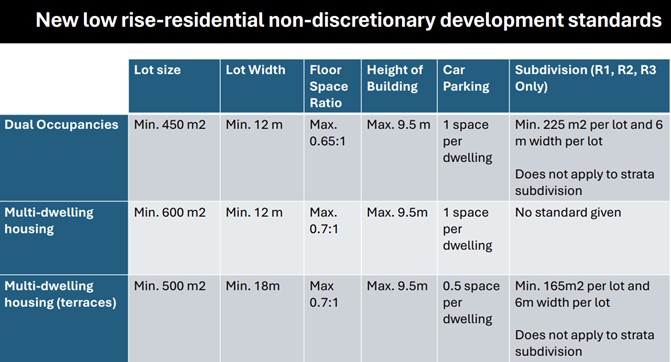
To simplify development assessments, the new rules introduce standardised minimum lot sizes and frontage requirements:
- Dual Occupancies: Minimum 450 m² with at least 12 m frontage
- Terraces: Minimum 500 m² with 18 m frontage
- Multi-Dwelling Housing (Townhouses): Minimum 600 m² with 15 m frontage
- Residential Flat Buildings: Minimum 500 m² with 12 m frontage (in applicable zones)
These consistent benchmarks reduce ambiguity, allowing developers to quickly determine whether a site is suitable before progressing to design and approval.
3. More Predictable and Streamlined Approvals
A major shift under the new framework is the introduction of non-discretionary development standards. Where a proposal meets the prescribed criteria, councils will no longer be able to refuse applications on those specific grounds.
This change provides greater certainty, shortens approval timeframes, and removes many of the subjective hurdles that previously delayed medium-density projects.
Why These Changes Matter
These reforms form part of the NSW Government’s broader response to housing supply and affordability challenges. By encouraging more housing near transport, employment, and services, the policy supports:
- Increased housing choice
- Better access to public transport
- More walkable, connected neighbourhoods
- Improved affordability through greater supply
For homeowners and investors, these changes provide an opportunity to build more affordable, modern homes in key locations, whether for sale or rent.